Independent · Non-commercial · Evidence-based ibogaine.info Updated August 2026

Ibogaine.info

The independent knowledge hub for ibogaine research, safety & policy

At a turning point

A controversial substance.
A pivotal moment
in medicine and policy.

Ibogaine is a psychoactive compound derived from the iboga plant, used in Central African spiritual tradition for centuries. Today it sits at the intersection of addiction medicine, neuroscience, and global drug policy — generating serious scientific attention and urgent regulatory debate.

This site exists to make the evidence clear, the risks honest, and the history understood — for patients, clinicians, journalists, and policymakers alike.

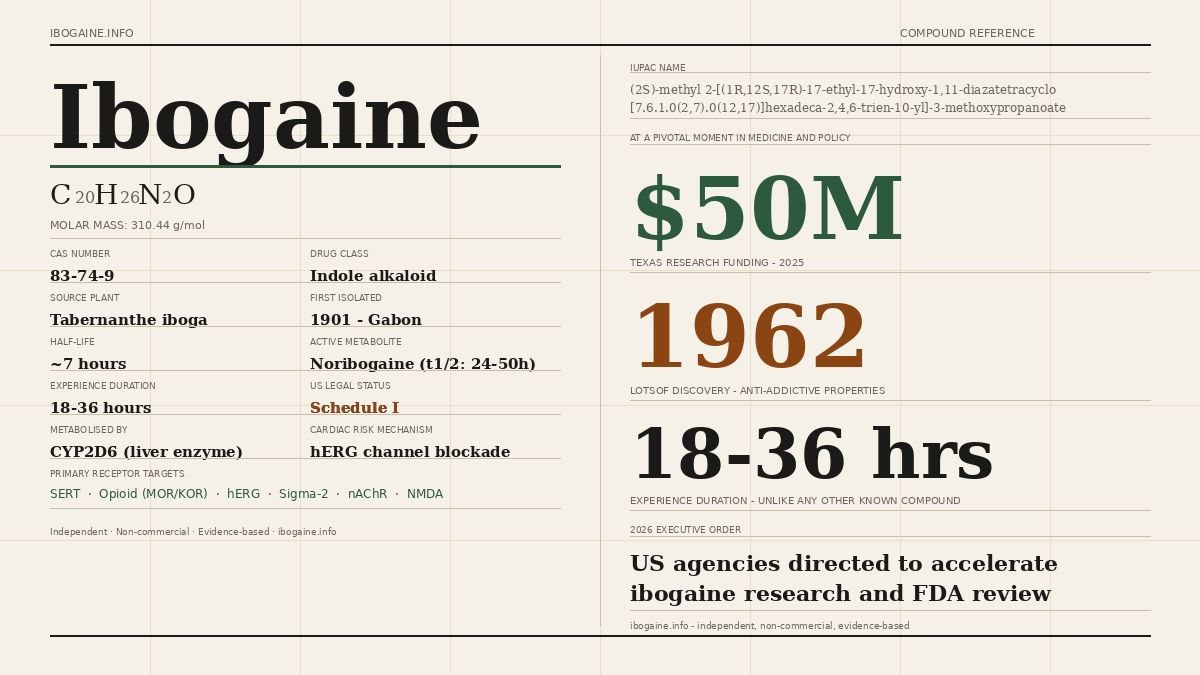
$50M
Allocated by Texas in 2025 for FDA-pathway ibogaine clinical research
2026
US executive order directing agencies to accelerate ibogaine review
18–36h
Duration of a full ibogaine experience — unlike any other known compound
1962
Year Howard Lotsof accidentally discovered ibogaine's anti-addictive properties

Where would you like to start?

I'm considering treatment

Understand what ibogaine treatment involves, what questions to ask any clinic, what the risks are, and how to find medically supervised care. Honest information — not marketing.

Start here →

I need reliable information for my work

For journalists, policymakers, and clinicians. Cited sources, systematic review summaries, legal status by country, and a policy timeline you can reference and link to.

Research resources →

I want to understand what this is

Start from the beginning. What ibogaine is, where it comes from, how it works, and why it's generating serious attention from scientists, veterans' advocates, and governments right now.

The full story →
Compound reference card for ibogaine — chemical formula C₂₀H₂₆N₂O, source plant Tabernanthe iboga, US Schedule I status, with key historical and policy milestones

Science & Research

What the evidence actually shows — and what it doesn't

Only two randomized controlled trials have been conducted on ibogaine for substance use disorders. Reviews from 2022 and 2023 describe preliminary anti-addictive potential — but also significant cardiac risks and a small number of fatalities. Here is what the research actually says, without the hype or the fear.

Read the evidence summary →

Explore by topic

01

History & Origins

From Central African forager tribes and Bwiti ceremony to Howard Lotsof's accidental discovery and the rise of underground clinics.

02

The Science

How ibogaine interacts with the brain's opioid, serotonin, and sigma systems — and why its mechanism is unlike any other known compound.

03

Safety & Risks

Cardiac risks, drug interactions, what supervised treatment looks like, and the questions anyone should ask before proceeding.

04

Law & Policy

Legal status country by country. The 2026 US executive order. Texas's $50M program. Where global regulation is heading.

Questions people actually ask

These are the questions that come up again and again in online forums and support groups, answered plainly. Where a claim rests on evidence, it links to the primary source. Where the honest answer is "we don't fully know yet," it says so.

Cost & access

How much does ibogaine treatment cost?

Costs vary widely between clinics and countries, and the figure tracks program length, the substance being treated, and above all the level of medical staffing and cardiac monitoring, not the comfort of the setting. Ask any provider for an itemised, written breakdown before paying a deposit, and be wary of a single lump-sum quote with no line for screening or monitoring. If a price looks low, check what has been left out.

Is microdosing iboga at home a substitute for a full treatment?

There is no scientific evidence that microdosing reproduces the effects studied in ibogaine research. The anti-addictive effect described in the literature involves a single large ("flood") dose given under medical supervision. Iboga carries cardiac risk at meaningful doses regardless of framing, and home use bypasses exactly the screening and monitoring that make supervised treatment safer.

Safety

How dangerous is ibogaine for the heart?

This is the central risk. Ibogaine prolongs the heart's QT interval and can trigger a potentially fatal arrhythmia called torsades de pointes. Most reported deaths have involved unsupervised settings or people who were never properly screened. A baseline 12-lead ECG, correction of electrolytes, and continuous cardiac monitoring are widely treated as the minimum standard, see the open-label safety study by Knuijver and colleagues (2022).

What conditions or medications rule someone out?

Common contraindications include pre-existing heart conditions, any medication that itself prolongs the QT interval, and significant liver impairment. This is not a checklist to self-assess, a responsible provider runs full cardiac and metabolic screening and will decline anyone who does not clear it. If a clinic is willing to proceed without that assessment, treat it as a red flag rather than convenience.

Why does magnesium keep coming up in newer protocols?

Because it appears to address the main danger directly. Stanford's MISTIC protocol co-administered magnesium to blunt ibogaine's QT prolongation and reported no cardiac events in its cohort of veterans with traumatic brain injury. That safety framing is a large part of why the approach has drawn serious scientific attention, and the study was published in Nature Medicine (2024).

Choosing a provider

How do I tell a legitimate clinic from a dangerous one?

Look for mandatory cardiac screening, continuous monitoring during the session, licensed medical staff physically present, honest and unprompted disclosure of the risks, and reviews on independent platforms rather than testimonials hosted on the clinic's own website. The clearest warning signs are the opposite: a provider who downplays the cardiac risk, skips screening, or guarantees results.

Evidence & law

Where is ibogaine legal?

It is Schedule I in the United States, legal in Canada, and prescription-only in New Zealand. Clinics operate in Mexico, the Netherlands, South Africa and elsewhere in legal gray areas. Status is shifting as US policy changes, see the full legal status map for the country-by-country picture.

Does it actually work long-term?

Only two randomised controlled trials on ibogaine for substance use disorders have ever been conducted. Observational data point to real short-term anti-addictive effects, but durable results depend heavily on integration and aftercare, and relapse is common without them. The honest summary is "promising but far from proven," which is why the current wave of state-funded trials matters.

Why do some clinics report near-perfect success rates?

Because those figures are almost always marketing, not research. Numbers like "90%+ resolution" typically come from a clinic's own website, self-reported and unaudited, sometimes "medically reviewed" by that same clinic's director. Genuine evidence is published in peer-reviewed journals and registered on ClinicalTrials.gov, where outcomes are far more modest and the caveats are stated openly. A useful rule: if a success rate isn't attached to a citation you can check, treat it as an advertisement.

Built to be cited,
not just read.

Every claim on this site links to its primary source. We are independent, non-commercial, and have no financial relationship with any treatment clinic, pharmaceutical company, or advocacy organization.

Primary sources only. Peer-reviewed research, official regulatory documents, and verified journalism. No secondary summaries without citation.

Safety is never buried. Risks and fatalities are presented clearly on every relevant page — not in footnotes.

Actively maintained. Policy and research developments are tracked and updated. This is not a static resource.

No affiliation. Independent, non-commercial, and editorially free from any treatment provider or advocacy group.